

Your body has more than one way of measuring age. While your birthday tells you how many years you’ve lived, your metabolic age reflects how efficiently your body uses energy compared to others your age. In many ways, it offers a clearer snapshot of your overall health than the calendar alone.
Metabolic age is shaped by daily habits—how you eat, move, sleep, and manage stress. In this article, we’ll break down what metabolic age really means, how it’s determined, and practical ways to improve it.
Metabolic age compares your basal metabolic rate (BMR) to the average BMR of people within your age group. Put simply, it shows whether your metabolism functions more like that of someone younger, older, or close to your actual age.
Your BMR is the amount of energy your body needs to keep you alive at rest. This includes essential functions such as breathing, circulating blood, maintaining body temperature, and supporting cellular processes. For most people, BMR accounts for about 60–75% of daily calorie expenditure.
When metabolic age is calculated, your measured or estimated BMR is matched against population averages. A higher-than-average BMR for your age typically results in a lower metabolic age, while a lower-than-average BMR produces a higher metabolic age.
Example:
If you’re 45 years old but your BMR aligns with the average 35-year-old, your metabolic age would be 35. If it matches that of a 55-year-old, your metabolic age would reflect that instead.
This concept emerged as researchers realized that chronological age alone doesn’t capture true health status. Two people born in the same year can have very different metabolic profiles depending on muscle mass, body fat, activity level, and lifestyle choices.
It’s important to note that metabolic age is not a medical diagnosis. Different devices and formulas may produce slightly different results, but the core idea remains the same: it’s a relative measure of how your metabolism compares to others.
Metabolic age can offer meaningful insight into overall wellness and long-term disease risk.
A lower metabolic age often reflects:
Muscle plays a critical role here. Because muscle tissue burns calories even at rest, people with more muscle tend to have faster metabolisms and better glucose control.
A higher metabolic age, on the other hand, may signal:
Over time, this metabolic slowdown is linked to increased risk of conditions such as type 2 diabetes, cardiovascular disease, metabolic syndrome, and certain cancers. While not a diagnosis, a higher metabolic age should be viewed as a prompt to reassess lifestyle habits.
Chronological age is fixed—it increases by one year, every year. Metabolic age is flexible and responsive to how you live.
You could be 50 years old chronologically but metabolically resemble someone in their 40s if you maintain muscle, stay active, and manage body fat. Conversely, a sedentary 30-year-old with poor nutrition may have a metabolic age well above their actual age.
This difference highlights an important truth: biological aging doesn’t progress at the same pace for everyone.
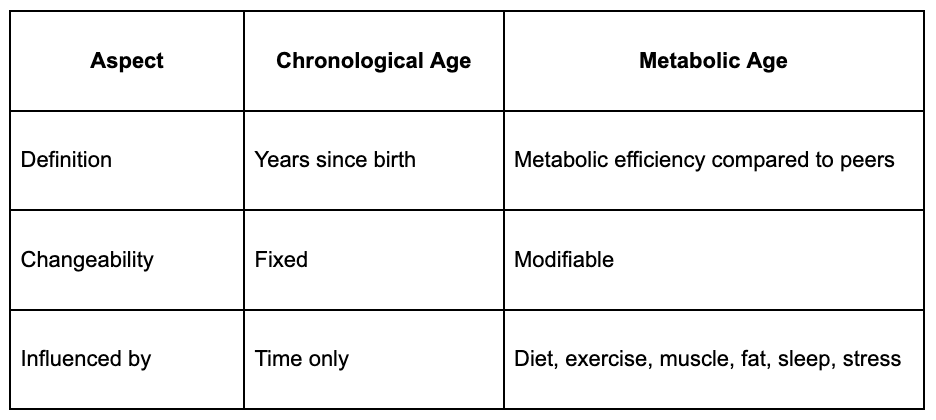
Focusing on metabolic age shifts attention toward factors you can control—making it a more empowering health metric.
While formulas vary by device, metabolic age calculations generally follow the same process.
BMR represents the calories your body needs at rest. The most precise way to measure it is through indirect calorimetry, which analyzes oxygen use and carbon dioxide output. Because this method requires specialized equipment, it’s usually limited to clinical or research environments.
Most modern body composition analyzers use bioelectrical impedance analysis (BIA). A small electrical current passes through the body, and because muscle, fat, and water conduct electricity differently, the device can estimate lean mass, fat mass, and total body water.
Once body composition data is available, equations are used to estimate BMR. Common formulas include Harris-Benedict, Mifflin-St Jeor, and Katch-McArdle. The Katch-McArdle equation often provides greater accuracy because it accounts for lean body mass:
BMR = 370 + (21.6 × lean body mass in kg)
Your calculated BMR is then compared to population averages across age groups. The age group your BMR most closely matches becomes your metabolic age.
Because manufacturers use different databases and algorithms, results may vary slightly between devices. Factors such as hormones, genetics, medications, and medical conditions may also influence metabolism in ways these calculations can’t fully capture.
If your metabolic age is higher than expected, the encouraging news is that it can improve with consistent lifestyle changes.
Muscle is metabolically active tissue. Pound for pound, it burns significantly more calories than fat. Strength training two to three times per week—covering all major muscle groups—can substantially raise your BMR.
Age-related muscle loss (sarcopenia) can begin in your 30s and accelerate later in life, making resistance training increasingly important as you age.
Adequate protein intake is essential for preserving and building muscle. Most adults benefit from consistent protein intake throughout the day, especially when paired with resistance training.
Avoid extreme calorie restriction. Severe dieting can slow metabolism through adaptive thermogenesis, making long-term progress harder to maintain. Instead, aim for balanced, nutrient-dense meals with moderate calorie control if weight loss is a goal.
Cardio supports metabolic health by improving insulin sensitivity and fat utilization. Both steady-state exercise and high-intensity interval training (HIIT) offer benefits.
General guidelines recommend 150 minutes of moderate-intensity or 75 minutes of vigorous-intensity aerobic activity per week.
Sleep plays a major role in metabolic regulation. Poor sleep disrupts hunger hormones, raises cortisol, and impairs glucose control. Consistently getting 7–9 hours of quality sleep supports muscle maintenance and fat metabolism.
Chronic stress keeps cortisol levels elevated, encouraging fat storage and muscle breakdown. Stress-reduction strategies—such as mindfulness, breathing exercises, time outdoors, or movement—can have a measurable impact on metabolic health.
Even mild dehydration can reduce metabolic efficiency. Alcohol adds empty calories, disrupts recovery, and interferes with muscle protein synthesis. Limiting intake often improves body composition outcomes.
Improving metabolic age takes time. Focus on habits you can maintain rather than quick fixes. Over weeks and months, small changes compound into meaningful improvements.
What does metabolic age indicate?
It shows whether your metabolism functions like that of someone younger, older, or similar in age compared to your chronological age.
Can metabolic age be improved?
Yes. Building muscle, eating well, exercising regularly, sleeping adequately, and managing stress can all lower metabolic age.
Is metabolic age a medical diagnosis?
No. It’s a helpful reference metric that should be considered alongside other health indicators.
Why might my metabolic age be high?
Common reasons include low muscle mass, excess body fat, inactivity, poor nutrition, lack of sleep, and chronic stress.
How long does it take to change metabolic age?
Noticeable changes typically occur over weeks to months of consistent lifestyle improvements.

Stay updated on our news and events! Sign up to receive our newsletter.